A custom fragrance packaging project has a fixed number of decisions and an almost unlimited number of ways to take them in the wrong order. Choosing a cap shape before the bottle neck is defined, or approving a surface finish before the decoration sequence is fixed, does not save time. It moves the cost to a later stage where it is more expensive.
Quick answer: Custom fragrance packaging develops in six stages: requirement consultation, design proposal, material and craft selection, sample development, mass production with full-process QC, and packaging and delivery. Each stage has one thing that must be locked before the next one starts — the market and volume, then the silhouette, then the materials, then the sample, then the inspection criteria, then the shipment plan.
Why sequencing beats speed
In a packaging project the expensive decisions are the ones that touch tooling. Bottle moulds, cap moulds and crystal tooling are the long-lead, hard-to-reverse items, and every decision made before them is cheap by comparison. The whole purpose of the six-stage sequence is to keep tooling decisions late enough that the information going into them is stable.
Put differently: the goal is not to compress the schedule everywhere. It is to spend time freely in the stages that are cheap to redo, so that the stages that are expensive to redo only run once.
Stage 1 — Requirement consultation
The first stage produces no drawings. It produces a brief that later stages can be judged against.
Six inputs should be settled here:
- Target market and positioning. Mass, masstige and prestige packaging are different products, not different price points on the same product.
- Product category. Perfume, essential oil, aroma and skincare place different demands on sealing and on the container’s relationship to its contents.
- Packaging style. The visual direction — minimal, ornate, architectural, natural.
- Quantity. The single most consequential number in the brief, because it decides whether dedicated tooling is amortisable.
- Budget envelope. A range, not a target, and ideally split between the bottle, the cap, the finishing and the carton.
- Customisation scope. What is being designed new — the silhouette, the cap, the finish, the crystal item, or the whole set.
Lock before moving on: the quantity band and the positioning tier. Both change every downstream recommendation, and both are frequently left vague at this stage.
Stage 2 — Design proposal
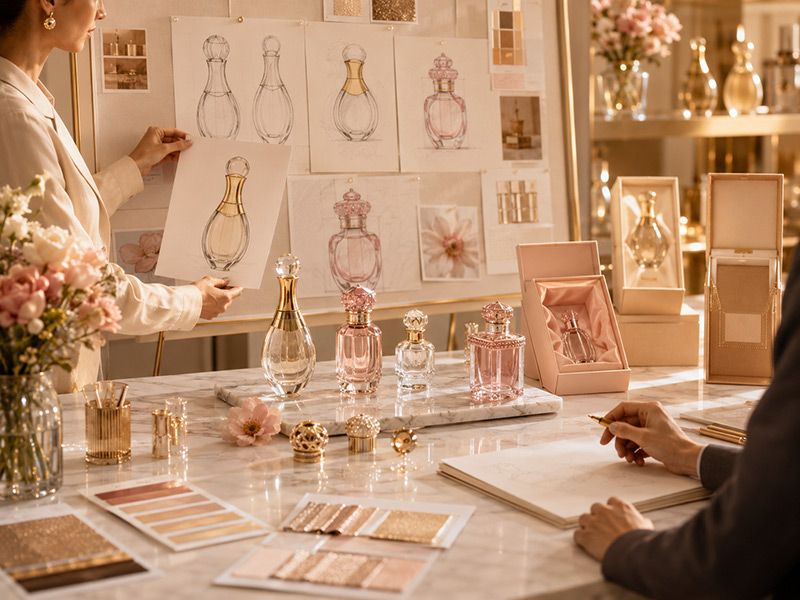
Design covers four elements that have to be resolved together rather than in sequence: bottle shape, cap structure, surface finish and decorative detail — plus the overall style that holds them together.
The reason they move together is purely physical. The cap structure depends on the neck finish, which depends on the bottle shape. The finish depends on the substrate chosen for each component. The decorative detail depends on which surfaces are flat enough for foil or print. Changing one late invalidates the others.

Lock before moving on: the silhouette of the bottle and the cap family (see our comparison of cap families for what that choice implies). Both feed the tooling decision in stage 4.
Stage 3 — Material and craft selection
This is where a packaging concept becomes a manufacturable product. Four material families are normally in play for fragrance packaging, and each one carries its own finishing routes.
| Material | Where it is used | Finishing routes | Selection driver |
|---|---|---|---|
| Glass | Perfume bottles, essential oil bottles, cream jars | Frosting, hot stamping, silk printing, embossing | Transparency and the way the formula reads through the body |
| Crystal | Incense burners, aroma storage canisters | Engraving, selective relief, minimal print | Light transmission and perceived collectible value |
| Zinc alloy | Perfume caps, decorative components | Electroplating, sandblasting, spray coating | Weight and true metallic surface |
| Plastic | Caps including floral caps, closures, inserts | Spray-free surface treatment, plating, printing, embossing | Silhouette freedom, low weight, tooling economics |
The craft selection runs alongside the material selection, because the two constrain each other. A deep frosting is not available on every glass body. A mirror electroplate needs a substrate that plates evenly. A fine embossed detail needs a tool that can hold it at the part size.
Lock before moving on: the material and finishing route for every component in the set, including the order in which finishing steps will be applied.
Stage 4 — Sample development
Sampling has three distinct purposes, and confusing them is a common source of delay: appearance confirmation, structural testing, and texture evaluation. Each requires the sample to be in a different state.
- Appearance confirmation needs the finish applied, because colour and gloss are the point.
- Structural testing is best done before decoration, so that a failure in the thread or the wall does not waste finished parts.
- Texture evaluation needs the final surface, because feel is decided by the outermost layer.
Where tooling is involved, expect at least two sample rounds: a first article to confirm the tool, then a decorated sample to confirm the finish. A brand that plans for one round will usually wait for two anyway, without having scheduled for it.
Lock before moving on: a signed and dated master sample for every component. This becomes the reference for the rest of the programme.
Stage 5 — Mass production and QC
Production is where the specification written in the previous four stages either holds or does not. Three inspection gates are standard in fragrance packaging: raw material selection, in-process production, and finished-goods inspection.
| Gate | What it catches | Why it cannot be moved later |
|---|---|---|
| Raw material | Off-spec glass, resin, alloy, crystal | Defects inherited from the material cannot be finished out |
| In-process | Drift in plating bath, frosting depth, moulding dimensions | The lot can still be corrected instead of scrapped |
| Finished goods | Appearance, assembly and packaging accuracy | Confirmed before the goods leave the site |
The in-process gate is the one most often skipped and the one with the highest return, because it is the only gate where a correction is still cheap. A plating bath drifting out of range is a non-event if it is caught in process and a full write-off if it is caught at final inspection.
Lock before moving on: the inspection criteria per gate, agreed in writing, plus who signs off on a conditional lot.
Stage 6 — Packaging and delivery
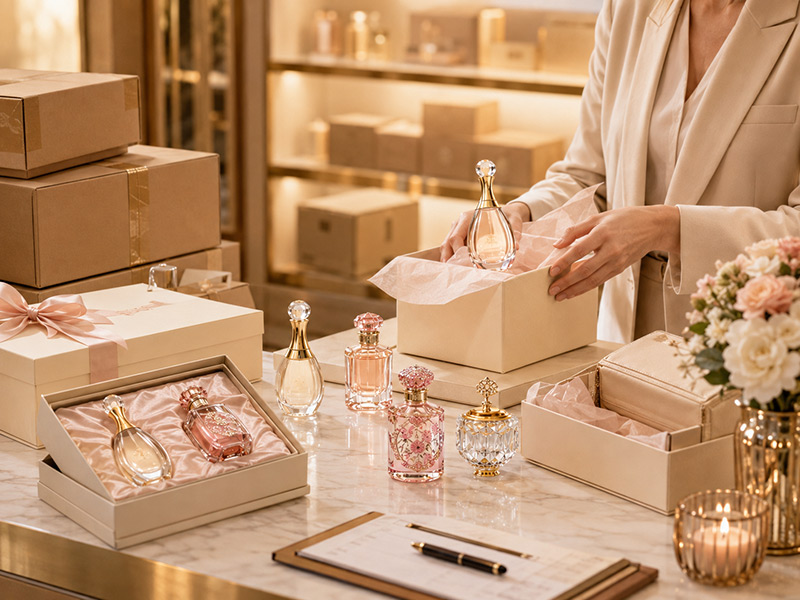
The last stage is not logistics admin. Fragrance packaging is fragile, decorative and often shipped as a set, which makes packing design a genuine engineering task:
- Component protection. Caps and crystal items are the parts most likely to arrive damaged, because they are the most decorated and the most exposed.
- Set integrity. If the bottle, the cap and the crystal item ship together, the cavity design has to keep them from contacting each other in transit.
- Final confirmation before shipment. One last check against the master sample and the packing specification, before the goods leave.
Lock before moving on: the packing specification and the final confirmation process. Both are cheap to write and expensive to improvise.
Four points where brands lose time
Across custom packaging projects, the same four mistakes account for most of the lost time:
- Briefing a design before the volume is known. The quantity decides whether tooling makes sense at all, so a design developed before it may be unbuildable at the target cost.
- Approving a finish before the decoration sequence. Order changes the result on combined finishes, so approval has to happen on the sequence, not on a single step.
- Planning one sampling round. Tooling rarely lands perfectly first time; the second round should be on the schedule from the start.
- Treating colour as a single decision. A matched set across glass, plated metal, printed plastic and crystal requires all finishes to be sampled together.
Working with a one-stop supplier
The six stages above are sequential for a reason, but the handovers between them are where delay accumulates. Every time a stage is split across two companies, it adds a queue, a re-explanation and a new opportunity for the specification to drift.
SUNDIS develops and manufactures premium fragrance packaging — glass perfume bottles, essential oil bottles, cream jars, zinc alloy and plastic caps including patented floral caps, and crystal incense burners with storage canisters — with design, sampling, moulding, finishing, assembly and quality control in one production chain. The R&D team develops packaging against brand positioning and market trends, and the standardised workshops run precision injection machines, automatic assembly lines and precision testing equipment for volume production.
The practical consequence for a brand is that the six stages can run as one programme rather than six procurements. A silhouette change, a finish correction and a cap tool adjustment all move through the same chain, which is what keeps a packaging project on the critical path instead of beside it.
If you are at stage 1 with a positioning brief and a volume estimate, send them across. That is enough to start a design proposal and to tell you what tooling the project will need.
Frequently asked questions
What is the correct order for a custom fragrance packaging project?
Requirement consultation, design proposal, material and craft selection, sample development, mass production with full-process QC, then packaging and delivery. The order matters because tooling decisions are expensive to reverse, so every stage before tooling exists to make those decisions stable.
How many sampling rounds should I plan for?
At least two when new tooling is involved: a first article to confirm the tool, and a decorated sample to confirm the finish and texture. Structural testing is best done before decoration and appearance confirmation after, so these are genuinely separate samples.
What must be decided before tooling starts?
Four things: the quantity band, the silhouette of the bottle and the cap family, the material and finishing route for every component, and the decoration sequence. If any of those is still open, starting tooling converts a cheap decision into an expensive one.
Can I develop just the cap and keep my existing bottle?
Yes. Sealing and thread dimensions are taken from the bottle neck, so a cap can be redesigned independently in most cases while the bottle tooling stays untouched. This is one of the fastest routes to refreshing an existing product’s shelf presence.
Does full-process QC mean every unit is inspected?
It means three defined gates: raw material selection, in-process production and finished-goods inspection. The in-process gate is the most valuable, because drift in plating, frosting or moulding dimensions can still be corrected while the lot is running instead of being written off at the end.
What information do I need to start a project?
Target market and positioning, product category, packaging style direction, expected quantity, budget range and the scope of customisation. Quantity and positioning are the two that most change the recommendation, so it is worth being specific about both even if the rest is still open.