

Two suppliers can quote the same bottle, the same cap and the same carton, and deliver products that do not look like each other. The difference is almost always finishing: which process was used, in what order, and to what tolerance.
Finishing is also the part of a brief that is most often written as a reference — “like this sample” — rather than as a specification. References travel badly. A sample sent to a supplier in July, reproduced in November, will drift unless the process and its acceptance criteria are written down.
Quick answer: Match the finish to the substrate first: electroplating and sandblasting belong on metal and platable plastic; hot stamping, silk printing and frosting belong on glass; embossing is formed in the tool and therefore suits moulded parts. Then specify the finish per zone, because the rim of a cap and the shoulder of a bottle wear at completely different rates.
Why finishing is specified last and fails first
Finishing sits at the end of the manufacturing chain, so it is the last thing scheduled and the first thing compressed when a launch date moves. Three structural problems follow:
- Drift. Plating bath chemistry, foil batch and glass surface all shift over a production run. Without a written target, the shift is invisible until finished goods are compared side by side.
- Order dependence. Frosting then printing gives a different result from printing then frosting. If the sequence is not specified, two factories will choose differently.
- Wear zones. A finish specified as an average over the whole part hides the fact that two small areas take most of the abrasion.
The fix is procedural rather than technical: name the process, name the sequence, and name the zones.
The six finishing routes
| Process | Typical substrates | What it delivers | Watch out for |
|---|---|---|---|
| Electroplating | Zinc alloy caps, platable plastics | Mirror or satin metallic surface with real reflectivity | Bath chemistry drift; edge build-up; wear at contact points |
| Sandblasting | Metal caps, some plastics | Matte, low-glare surface that resists fingerprints | Grain consistency across lots; masking of areas to stay glossy |
| Hot stamping | Glass, plastic, board | Metallic or coloured foil, usually for a logo | Foil adhesion on curved or frosted surfaces; registration |
| Silk printing | Glass, plastic, crystal | Flat colour, fine linework, multiple colours in passes | Colour registration between passes; opacity on dark glass |
| Frosting | Glass bottles and jars | Translucent matte effect that softens the contents | Depth control; interaction with any print applied afterwards |
| Embossing | Moulded caps and plastic parts | Relief detail formed in the tool | Tool cost; draft angles; detail loss at very small scale |
Glass: frosting, printing and the seam problem
Glass perfume bottles and cream jars are usually specified with one of three surface routes: clear, frosted or coated. Frosting is the most requested and the most mis-specified, because “frosted” describes a family of surfaces rather than one.
Three controls decide the result:
- Depth of the matte layer. A shallow frost reads as a haze over clear glass; a deep frost reads as a solid matte surface. Under a bright retail light the two look like different products.
- Uniformity around the body. Glass is not a uniform surface. Mould seams, thickness variation and the base curve all take frost differently.
- Interaction with printing and hot stamping. A matte surface has more grip and more surface area than clear glass, so ink and foil behave differently. Frosting after printing is a different product from printing after frosting.

For essential oil bottles and cream jars, the same logic applies with a different constraint: the contents are often opaque or highly coloured, so the glass surface is doing less work and the cap is doing more. In those projects it is usually more efficient to spend the finishing budget on the cap and keep the glass simple.
Metal and plastic caps: plating versus spray-free
On caps, the choice is increasingly between a plated surface and a surface produced without conventional spraying. The two routes are not equivalent in use.
| Consideration | Electroplated finish | Spray-free moulded finish |
|---|---|---|
| Appearance | True metallic reflection; deep mirror possible | Metallic appearance with controlled gloss and gradient |
| Structure | Coating sits on the substrate; can blister or peel at sharp edges | Seamless integrated structure; no applied layer to delaminate |
| Wear behaviour | Rub-through at rim and shoulders over repeated handling | Wear resistance comes from the material and the tool surface |
| Weight | Suits zinc alloy, which is heavy by nature | Keeps the lightweight profile of plastic |
| Process steps | Requires plating line plus masking | Finishing integrated into moulding — fewer handover steps |
The spray-free route exists for a specific reason: conventional spraying on a moulded cap adds an applied layer, and applied layers fail at edges. Integrating the finish into the moulding removes that failure mode and removes a process handover at the same time.
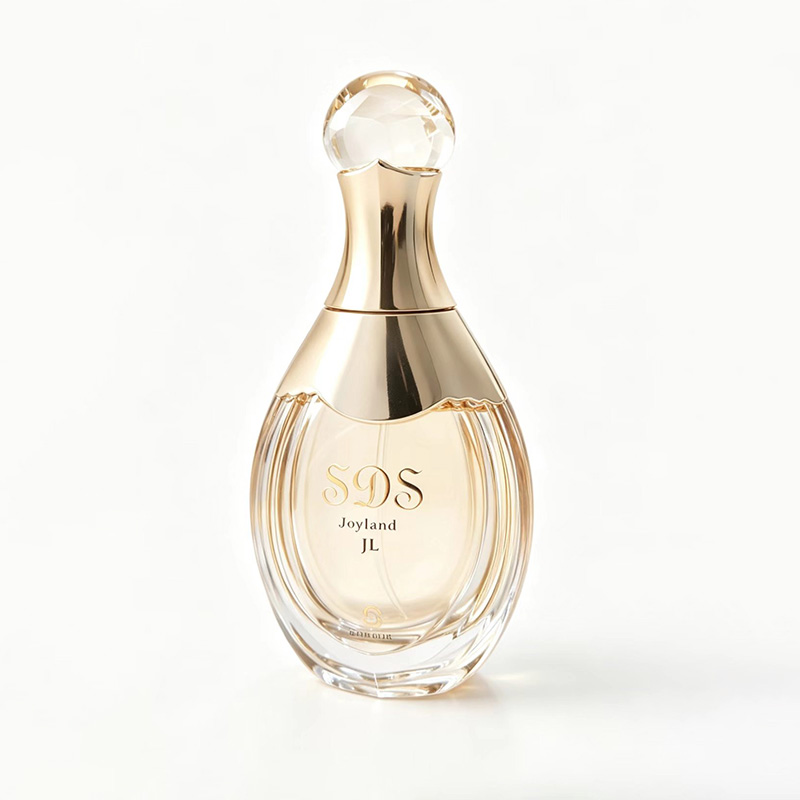
Sandblasting is worth considering as a finishing step on either route, because a matte surface hides handling marks better than a mirror surface. On a cap that will be opened repeatedly, the matte route often looks newer after a year of use than the mirror route did after a month.
Crystal and aroma products
Crystal incense burners and aroma storage canisters introduce a fourth substrate. Crystal is valued for light transmission and internal structure, so the finishing principle inverts: on glass the finish often conceals, on crystal it should reveal.
Two practical notes:
- Keep the optical surfaces free of decoration. Any print or foil placed over the light path reduces the transmission the material was chosen for.
- Concentrate detail where the light exits. Engraving or relief around the light-emitting zone produces depth; the same detail on an opaque area is simply texture.
Because these items are frequently sold in gift sets alongside a perfume bottle, the cross-substrate colour match described below matters more here than anywhere else in a fragrance range.
Combining finishes on one product
Most premium fragrance packages combine at least two finishes: a frosted bottle with a hot-stamped logo and a plated cap is a standard configuration. Three rules keep combinations from going wrong:
- Decide the order before the sample. Frosting depth changes ink adhesion; plating changes the flatness that foil registration depends on.
- Protect the contact zones. Identify where the part is touched and where it touches other parts, then specify abrasion resistance for those areas specifically.
- Develop colours together. The same nominal gold appears different on electroplated metal, printed plastic, hot-stamped foil and uncoated crystal. If the set must match, the finishes have to be sampled as a set.
Writing a finish specification
A finish specification that survives production contains six lines:
| Line | What to state | Why it matters |
|---|---|---|
| Process | The named process, not a reference image | Two factories interpret an image differently |
| Substrate | Exact material and, for glass, the mould | The same process behaves differently on different substrates |
| Sequence | Order of all finishing steps | Order changes the result on combined finishes |
| Zones | Which areas receive which finish, and which stay bare | Handling and contact zones need different treatment |
| Acceptance criteria | Gloss, colour target and abrasion requirement per zone | Turns “looks right” into a pass or fail |
| Sample reference | A signed and dated master sample | Anchors the target across a long production run |
The master sample is the single most useful document in the pack. Everything else describes intent; the master sample settles disputes.
How SUNDIS controls finishing
SUNDIS runs finishing across glass, crystal, zinc alloy and plastic under one roof, which is what makes a matched set practical rather than a coordination exercise. The available processes include composite injection moulding, electroplating, hot stamping, silk printing, embossing and frosting, plus spray-free surface treatment and sandblasting on caps.
Quality control runs as a full-process gate: raw material selection, in-process production and finished-goods inspection. For finishing specifically, the value of the in-process gate is that a plating bath or a frosting depth drifting out of range is caught while the lot can still be corrected, rather than after the parts are decorated and packed.
Because design, sampling, moulding, finishing and assembly sit in one production chain, a brand can approve a bottle, a cap and a crystal item as one finish set. That removes the most common source of late-stage rework in fragrance packaging: three parts, three suppliers, three colour targets.
Frequently asked questions
Which finishing process gives the most durable metallic look on a cap?
It depends on the failure mode you are protecting against. Electroplating gives the truest reflection but can rub through at the rim under repeated handling. A spray-free moulded finish trades a little reflectivity for a seamless structure with no applied layer to delaminate. For caps that will be opened many times, durability usually favours the integrated route.
Can hot stamping be applied over a frosted glass bottle?
Yes, but the frosting depth must be fixed first, because a matte surface has more grip and more surface area than clear glass, so foil adhesion and the visual result both change. Sequencing — frost then foil, or foil then frost — produces different products, so it must be specified rather than left to the decorator.
Does frosting reduce the visible fill level?
It changes how the contents read, not the actual fill. A frosted body diffuses the formula behind it, which often makes a pale liquid look softer and a coloured liquid look more uniform. If fill level visibility matters at the point of sale, that should be checked on a frosted sample rather than a clear one.
Why do the same gold colours not match across a bottle, a cap and a crystal item?
Because four different finish routes are involved: electroplated metal, printed or coated plastic, hot-stamped foil, and uncoated crystal. Each shifts the same nominal colour differently. To match a set, all the finishes have to be sampled together in one development cycle.
What is spray-free surface treatment?
It is a finishing route where the appearance of a moulded part — metallic look, gloss level, colour integration — is produced through integrated composite injection moulding and specialised surface finishing instead of conventional spraying. The practical benefit is a seamless part with no applied coating to wear, blister or peel at edges.
How should abrasion resistance be specified?
Per zone, not as an average across the part. Identify where the product is handled and where it contacts other components, then set the abrasion requirement for those areas. A part with excellent average finish and a weak rim will still look worn in the customer’s hand.