
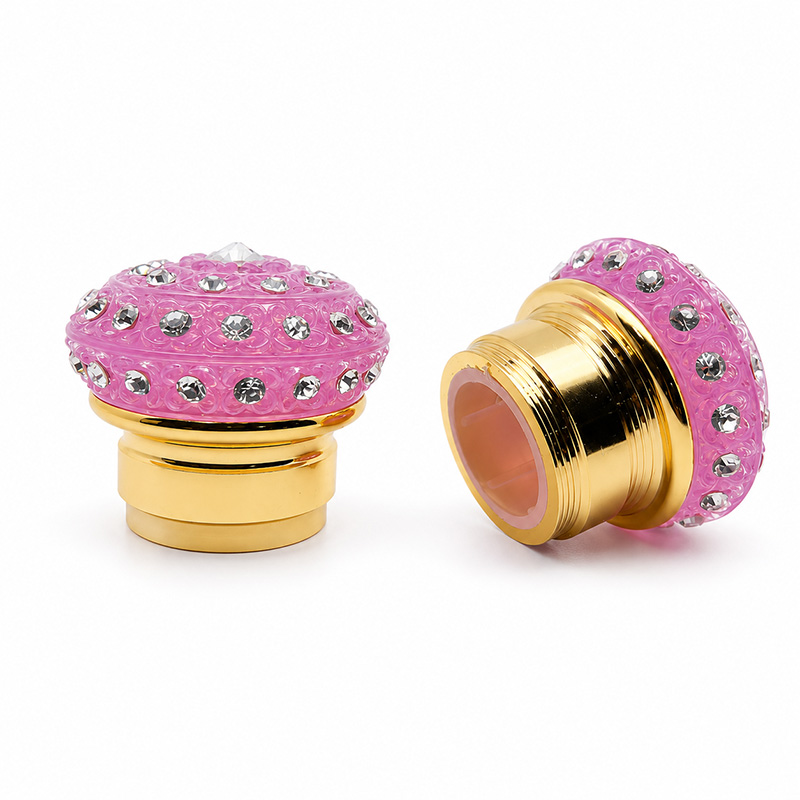
The cap is the first part of a fragrance package a customer touches. It sets the weight in the hand, produces the sound at closing, and carries the logo at the moment of unboxing. Yet caps are usually specified last, after the bottle and the carton, with whatever budget remains. That order is backwards, and it shows on the shelf.
Quick answer: Choose a plastic floral cap when differentiation and light weight matter; choose zinc alloy when perceived weight and metallic finish are the priority target; choose a standard plastic cap when unit cost and tooling speed dominate. All three can be produced with the same thread and sealing dimensions, so the decision is reversible without changing the bottle.
What the cap actually does
A perfume cap performs four functions at once, and they pull in different directions:
- Sealing. It holds the crimp collar or the screw neck and limits evaporation during storage, transport and the months a bottle sits on a shelf.
- Structure. It resists the force of being pulled off, twisted and dropped without cracking at the thread or the wall.
- Identity. Shape, surface and weight transmit the positioning of the brand before the consumer reads a single word.
- Assembly. It has to fit the filling line, the crimping machine and the carton cavity without tolerance fights.
Most specification failures come from optimising one of these four and quietly breaking another. A cap engineered purely for weight becomes too heavy for the carton board. A cap engineered purely for cost cracks when a tester pulls it off by the rim. A cap engineered purely for looks fails the assembly line.
The three cap families compared
SUNDIS produces fragrance caps in three families for perfume, essential oil and aroma projects. They are not ranked — they solve different problems.
| Attribute | Patented plastic floral cap | Zinc alloy cap | Standard plastic cap |
|---|---|---|---|
| Base material | Engineering plastic, composite injection moulded | Zinc alloy (die cast), usually over an insert | ABS / PP / acrylic, single-shot moulded |
| Surface route | Integrated finishing — no conventional spraying | Electroplating, sandblasting, spray coating | Spray coating, plating, printing |
| Typical weight | Lightweight; metallic look without metal mass | Heavy; delivers the classic premium hand-feel | Lightest of the three |
| Best for | Brands needing a signature cap that stands out in a crowded shelf set | Ultra-premium and gift sets where weight is part of the promise | Volume programmes, refills, travel sizes, cost-led briefs |
| Tooling lead time | Longer — the floral geometry needs dedicated tooling | Moderate | Shortest |
| Unit cost at scale | Mid to high, offset by eliminated spraying steps | High (material and plating both carry cost) | Low |
| Differentiation ceiling | High — stereoscopic layered textures, gradient light transmission, embossed carving | Medium — differentiation comes mainly from finish | Low — differentiation comes mainly from print |
The plastic floral cap is the component SUNDIS is known for. Instead of spraying a colour onto a moulded shell, the appearance is built through integrated composite injection moulding plus specialised surface finishing. The result is a seamless one-piece structure that reads metallic in the hand but keeps the weight and toughness of plastic.
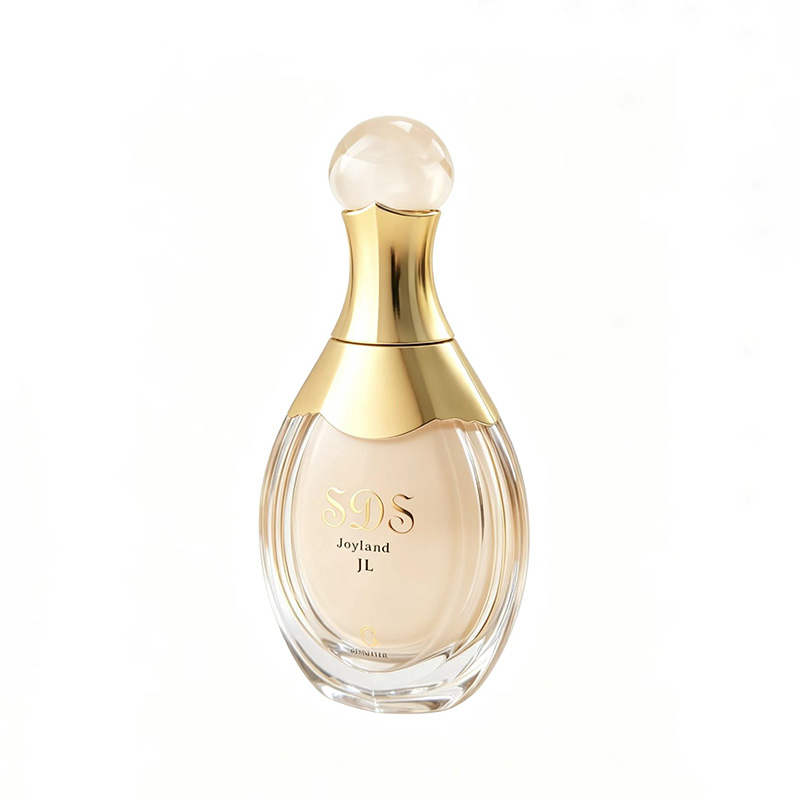
Three design capabilities matter when a brand wants a floral cap rather than a plain one:
- Stereoscopic layered floral texture. The petals have depth and shadow under raking light, which is what separates it from a printed pattern.
- Multi-colour integration and gradient light transmission. Several colours in one moulded part, with light passing through some zones and not others.
- Embossed carving. Relief detail fine enough to carry a logo or a petal vein without a separate decoration step.
Practical performance is not traded away for the look. Floral caps are specified as anti-slip, scratch-resistant and high-sealing, which matters because a decorative cap that scratches in transit arrives at the counter already looking used.
Sealing: the specification that gets skipped
Sealing is usually treated as the bottle’s job. It is not. The cap controls how evenly the sealing force is distributed around the neck, and that distribution decides whether a bottle lost to evaporation in month six is a formula problem or a cap problem.
Three variables do most of the work:
- Wall concentricity. A cap wall that is 0.2 mm off-centre on a screw cap loads one side of the gasket and leaves the other side loose.
- Internal rib geometry. Ribs give the cap grip during assembly and hold the insert. Too deep and the wall thins; too shallow and the cap slips on the crimping head.
- Insert seating depth. On zinc alloy caps, the insert carries the actual engagement with the neck. If it is not seated to a controlled depth, the metal shell looks correct but the cap does not grip.
Whatever the family, the sealing dimension is taken from the bottle neck — not invented for the cap. That is also why switching cap families later is often cheaper than expected: the thread and the collar stay, and only the shell changes.
Weight, sound and perceived quality
Consumers use weight as a proxy for quality, and they use the closing sound as confirmation. Both are legitimate design targets, and both have to be specified deliberately rather than inherited from whichever cap family was chosen first.
| Perceived cue | How it is engineered | Trade-off to watch |
|---|---|---|
| Heft in the hand | Zinc alloy mass, or a plastic shell with added internal mass | Carton board strength, shipping weight, bottle stability on a narrow base |
| Closing sound | Insert material, rib fit against the neck, wall stiffness | A very tight fit raises assembly force and can stress the neck |
| Surface coolness | Metal in contact with the skin | Plating thickness and wear over repeated handling |
| Light play | Gradient light transmission in a moulded floral cap | Colour control across production lots |
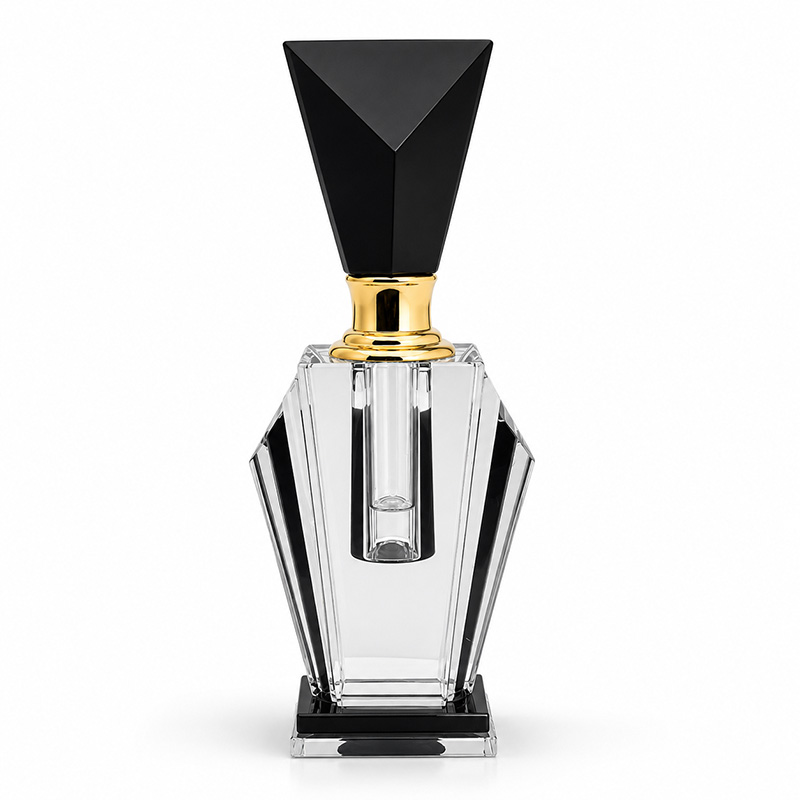
A common mistake is to make every SKU in a range feel identical. In a range built around one signature silhouette, the entry SKU and the flagship SKU are often better served by different cap families — for example a plastic floral cap on the volume line and a zinc alloy cap on the gift set — so that the flagship is physically heavier than the line it anchors.
Decoration and finishing options
The cap is where finishing steps are most visible, because it is handled most. Available processes include:
- Electroplating — mirror and satin metallic finishes on zinc alloy and on platable plastics.
- Sandblasting — a matte, low-glare surface that hides fingerprints better than a mirror finish.
- Hot stamping — metallic or coloured foil, usually for a logo on a flat or gently curved face.
- Silk printing — flat colour and fine linework, including on small cap tops.
- Embossing — raised detail formed in the tool, so it cannot wear off.
- Spray-free surface treatment — the route used on the floral cap family, where the finish comes from the moulding and the tool surface rather than a painted layer.
Two selection rules are worth applying. First, any finish that lives on the outermost layer will wear at the points of contact — the cap rim and the shoulders — so abrasion resistance should be specified for those zones specifically. Second, if a brand wants the same colour across a glass bottle, a cap and a crystal item, the finishes will not match unless they are developed together; electroplated metal, printed plastic and uncoated glass all shift the same nominal colour differently.
A six-point selection framework
Run every candidate cap through these six questions before committing to tooling:
- What must the cap protect? Formula sensitivity, fill volume and expected shelf life set the sealing requirement.
- What does the shelf demand? If the surrounding set is visually loud, a plain cap disappears; if it is minimal, a floral cap over-decorates.
- What weight should the product have in the hand? Decide the target and confirm the bottle base and carton can carry it.
- Which family reaches that target at the briefed volume? Tooling amortisation changes the answer completely between 5,000 and 500,000 pieces.
- Can the finish survive the journey? Specify abrasion resistance at the contact zones, not the average of the part.
- Does it fit the filling line? Confirm the crimping or capping head, the torque target and the carton cavity before sampling.
How to evaluate a cap supplier
Caps are where a fragrance project is most often delayed, because tooling sits on the critical path and decoration sits after it. When evaluating a supplier, ask four questions:
- Is the moulded cap made in-house or bought in? In-house moulding means the tool can be corrected without a third party’s queue.
- Which finishing steps are done on site? Each outsourced step is an extra handover with its own lead time and its own colour drift.
- What is inspected, and at which stage? Raw material, in-process and finished-goods inspection are three different gates; ask which ones actually stop a lot.
- Who owns the tool? Confirm ownership and transfer terms before tooling starts, not after.
SUNDIS develops and moulds fragrance caps in-house, including the patented floral cap family, and runs a full-process QC gate from raw material selection through in-process production to finished-goods inspection. Because the cap, the glass bottle and the crystal aroma items are developed under one roof, the colour and surface across a complete set can be matched in the same development cycle rather than reconciled afterwards.
Frequently asked questions
Can a plastic floral cap achieve a metallic look without plating?
Yes. Through integrated composite injection moulding with specialised surface finishing, the metallic appearance is produced without conventional spraying and without a plated layer, so there is no plated coating to wear or blister. The cap keeps the weight and toughness of plastic.
Is a zinc alloy cap always the more premium choice?
No. Zinc alloy delivers weight and a true metal surface, which suits gift sets and ultra-premium positioning. But for a range that needs a distinctive silhouette and a lighter shipping profile, a moulded floral cap can read as more designed while costing less per unit once the eliminated finishing steps are counted.
Can I change the cap family later without changing the bottle?
In most cases yes. The thread and the sealing dimensions are taken from the bottle neck, so the shell can be redesigned while the bottle tooling stays. This keeps the decision reversible and is why the cap should be specified as a family plus a silhouette, not as one fixed part number.
How many colours can be integrated into a moulded cap?
Multi-colour integration with gradient light transmission is achievable in one moulded part, so several colours and different degrees of translucency can coexist without a printing step. The practical limit is set by the tool and by how much colour separation is visible at the part size.
How do I specify the sealing requirement correctly?
Give the supplier the fill volume, the formula sensitivity, the expected shelf life and the storage and transport conditions. From those, the gasket and the wall tolerance can be set. Specifying sealing as a percentage figure alone does not tell the mould shop what to hold.
What should be confirmed before sampling a custom cap?
The silhouette and the family, the target weight, the finish and its abrasion zones, the filling-line head and torque target, the carton cavity, and the quantity that will amortise the tooling. Sampling before the quantity is known usually leads to a redesign after the quote.